
Project Gallery
National Heavy-Duty Metal Forming Machine with BRANKAMP PK 4000
Description
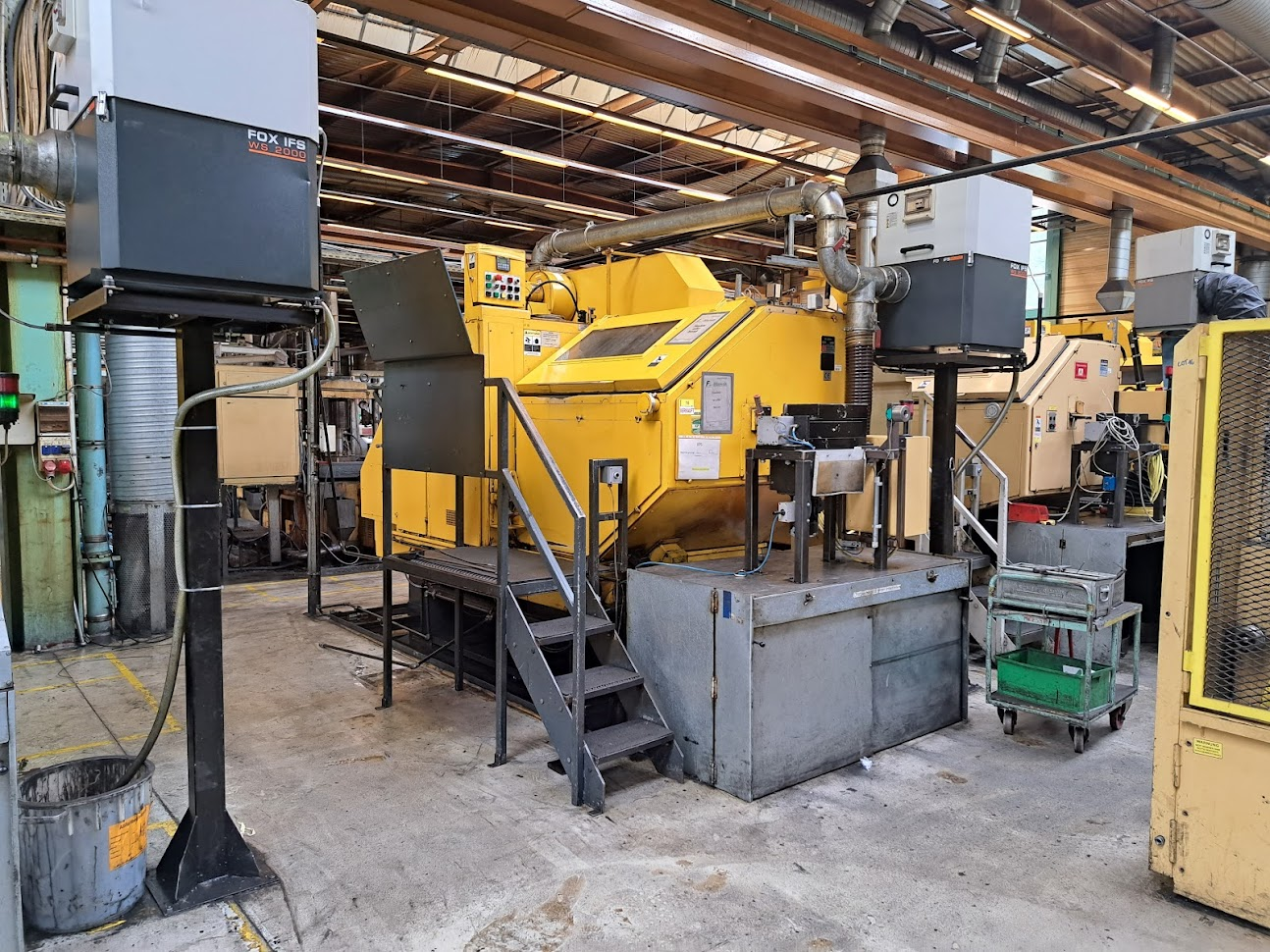
This is a National industrial metal forming machine equipped with a BRANKAMP PK 4000 process monitoring system, configured for high-volume production and in-process monitoring of forming operations. The machine combines a heavy-duty enclosed forming structure, powered production mechanism, integrated material-handling arrangement, electrical controls, process-monitoring equipment, and dedicated extraction/ventilation infrastructure. The main machine is built around a large enclosed forming and production unit with a substantial yellow-painted industrial housing. The enclosed construction provides a controlled working area around the forming mechanism and protects the operator from moving mechanical components during production. The machine architecture is designed for repetitive manufacturing, with the primary forming mechanism, drive components, tooling area, controls, and auxiliary systems integrated into one production installation. A particularly important component is the BRANKAMP PK 4000 process monitoring system. The PK 4000 is designed for process monitoring on presses, stamping machines, thread rollers, and other metal-forming equipment. It uses multiple sensor inputs to monitor forming processes, including maximum force and process trends, while providing production counters and process-quality information. The installed BRANKAMP unit is identified as PK 4000, manufactured in Germany, with the equipment identification showing 2008 and serial number 9496. The unit provides dedicated connections for sensors and machine interfaces, together with status indicators for power, machine halt, CPU operation, and production cycles. This allows the forming process to be continuously supervised during operation. The BRANKAMP monitoring system is particularly valuable in metal-forming production because it can monitor forming loads and detect abnormal process conditions. Brankamp systems are designed to protect machines and tooling against overloads, detect process disturbances, support faster machine setup, and identify production-quality problems during manufacturing. The monitoring system also supports 100% in-process inspection of manufactured parts in suitable forming applications. Process signals can be evaluated against established limits and reference curves, allowing abnormal forming conditions to be detected during production rather than only during subsequent inspection. In applications such as cold forming, this technology can help identify issues including tool breakage, transfer errors, excessive forming loads, and certain part defects. The machine incorporates a dedicated operator control station with multiple push buttons, selector switches, indicator lamps, emergency-stop equipment, and a display interface. These controls provide direct access to the machine's production functions and allow operators to monitor machine status and control the various operating sequences. The production unit is supported by a substantial mechanical drive system, with heavy-duty housings, shafts, rotating components, bearing assemblies, guards, and associated transmission equipment. The robust construction is suitable for repetitive production cycles and the mechanical loads generated during industrial metal forming. A dedicated material-handling and production-feed arrangement is incorporated into the machine installation. The enclosed production configuration allows components or raw material to move through the forming process in a controlled sequence. This type of arrangement is particularly appropriate for high-volume manufacturing where consistent processing and repeatable production cycles are required. The machine is also integrated into an industrial dust and process-extraction system. Large extraction ducts are positioned above the production equipment and connected to dedicated filtration/extraction units. This infrastructure supports a cleaner production environment by removing airborne particles and process contaminants generated during industrial manufacturing operations. The surrounding production installation includes additional enclosed forming equipment, electrical cabinets, extraction units, material containers, access platforms, and auxiliary production equipment. This indicates a production-oriented configuration intended to operate as part of a larger manufacturing environment rather than as an isolated workshop machine. The BRANKAMP PK 4000 provides an additional level of machine, tooling, and process supervision. Its monitoring functions include maximum-force monitoring, trend monitoring, order counting, tool-life or maintenance counting, stroke-rate information, and process-quality evaluation. These functions help operators maintain consistent production conditions and identify deviations during manufacturing. The system also supports reference-based process monitoring, allowing established process limits and production parameters to be used for repeatable setup and monitoring. Brankamp describes its systems as being used extensively in cold forming, stamping, forging, and other metal-forming applications, with the objective of improving productivity and manufactured-part quality while reducing machine and tooling damage. The combination of the National forming machine and BRANKAMP PK 4000 monitoring technology makes this installation particularly suitable for demanding production environments where high repeatability, process supervision, and tooling protection are important. The machine's heavy-duty construction provides the mechanical foundation for production, while the electronic monitoring system continuously evaluates important process conditions. This equipment is well suited to industrial applications involving metal forming, stamping, pressing, cold forming, fastener production, automotive components, mechanical components, and other high-volume manufactured metal parts. Brankamp specifically identifies applications involving screws, nuts, rivets, balls, rollers, and other cold-formed products.