
Project Gallery
Droop+Rein Large-Format Gantry CNC Machining Center
Description
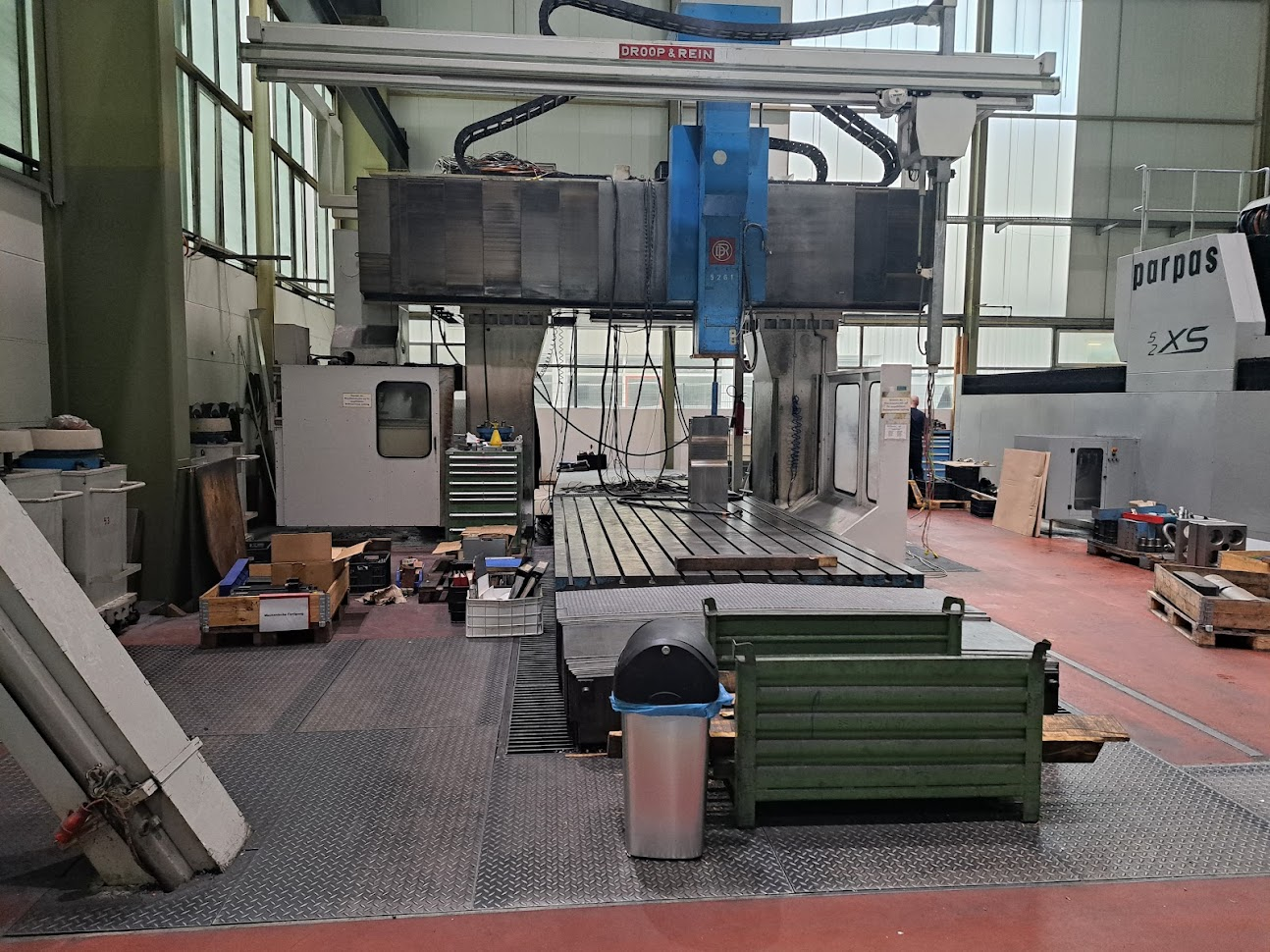
This Droop+Rein large-format gantry machining center is a heavy-duty industrial machine designed for the machining of large, complex, and heavy workpieces. Its substantial gantry construction, large working table, rigid structural frame, movable machining head, and integrated CNC movement systems make it suitable for demanding applications where high machining capacity and a large working envelope are required. The machine is built around a robust gantry-style architecture, with two large vertical supports carrying a heavy horizontal crossbeam. The crossbeam provides the main structure for the machining carriage and allows the cutting head to travel across the working area. This configuration provides considerable machining access over large components while maintaining the rigidity required for heavy industrial machining. A large T-slot machining table forms the main working surface of the machine. The table is constructed from multiple heavy-duty sections and provides numerous longitudinal slots for securing workpieces, fixtures, clamping equipment, and specialized tooling. The extensive table area allows large components to be positioned securely within the machine's working envelope and provides flexibility for different workholding arrangements. The machine's main machining unit is mounted on a large movable vertical carriage positioned on the gantry beam. The carriage incorporates the machining head and associated drive and positioning mechanisms required for controlled machining operations. The substantial construction of the vertical machining assembly is designed to provide stable positioning while machining large components. The Droop+Rein name is prominently integrated into the machine's overhead structure. Droop+Rein is associated with large-format machine tools and heavy-duty machining systems, particularly equipment designed for applications requiring substantial working dimensions and rigid machine construction. The machine's overall architecture reflects this class of industrial equipment. The horizontal gantry contains precision linear movement systems that allow the machining carriage to travel along the main axis. The visible guideways, drive components, protective covers, and cable-management systems are integrated into the gantry to support controlled movement of the machining head. These systems are essential for maintaining accurate positioning throughout the machine's working envelope. The vertical machining carriage provides additional controlled movement of the machining head. Its heavy-duty construction allows the cutting tool to be positioned at different heights relative to the workpiece. Together, the gantry movement and vertical carriage provide access to a substantial portion of the work area and enable the machining of large components with complex geometries. Extensive energy-chain and cable-carrier systems are incorporated into the machine. These systems guide electrical cables, control wiring, and other flexible connections as the machining assemblies move. Proper cable management is particularly important on large gantry machines because the machining head may travel considerable distances during operation. The machine also incorporates protective and enclosed sections around its moving mechanical components. These structures help protect the machine's precision movement systems and provide a controlled environment for the mechanical assemblies. The combination of protective covers, guideways, cable carriers, and rigid structural members contributes to the machine's industrial configuration. The machine is installed in a spacious production facility with substantial overhead clearance and dedicated industrial infrastructure. The surrounding workshop provides sufficient space for the handling of large workpieces, tooling, maintenance equipment, and supporting production machinery. The installation includes industrial flooring, overhead lifting infrastructure, storage areas, service equipment, and other machinery associated with large-scale manufacturing operations. An overhead Droop+Rein material-handling or auxiliary gantry system is positioned above the main machining area. The overhead arrangement provides additional support for handling equipment and machine-related components. In large machining facilities, such lifting infrastructure is particularly useful for positioning heavy workpieces, fixtures, tooling, and machine components. The large table and open gantry configuration make this machine suitable for machining components that may be too large for conventional enclosed machining centers. The machine architecture provides direct access to the workpiece from the front and sides while allowing the machining head to travel across the component. Large-format gantry machining centers are commonly used for heavy engineering, aerospace structures, energy equipment, transportation components, industrial machinery, large fabricated structures, dies, moulds, frames, and other oversized components. The exact application depends on the installed spindle, tooling, machine travels, CNC configuration, and workpiece requirements. The rigid construction of the machine is particularly important when machining large components. Heavy workpieces can generate significant cutting forces, and the machine structure must provide sufficient rigidity to maintain stable machining conditions. The substantial columns, crossbeam, carriage, and table are designed around this requirement. The machine's T-slot table also provides considerable flexibility in workholding. Different fixtures and clamps can be positioned according to the dimensions and geometry of the workpiece. This makes the machine suitable for a wide variety of large-component machining operations rather than being limited to a single component type. The machining head is supported by a substantial vertical carriage and incorporates the mechanical components necessary for controlled cutting operations. Depending on the installed configuration, such a machining system can perform operations such as milling, drilling, boring, tapping, and other material-removal processes using appropriate tooling and CNC programming. The machine's CNC architecture allows machining movements to be coordinated according to programmed tool paths. This is particularly valuable when producing large components with multiple features, complex profiles, drilled patterns, pockets, surfaces, or other accurately positioned geometries. CNC control also allows repeatable machining cycles once the appropriate programs, tooling, workholding, and process parameters have been established. The surrounding installation also contains additional industrial equipment and machinery, demonstrating that the machine operates within a larger manufacturing environment rather than as an isolated workshop unit. Supporting equipment can include lifting systems, tooling storage, inspection equipment, auxiliary machines, material-handling equipment, and maintenance infrastructure. The machine's substantial footprint and large working area require an appropriately designed production facility. Adequate floor capacity, overhead clearance, electrical supply, lifting capability, access routes, and maintenance space are important considerations when installing and operating equipment of this scale. Maintenance of a machine in this class typically involves regular inspection of linear guideways, drive systems, lubrication systems, cable carriers, electrical components, spindle assemblies, hydraulic or pneumatic systems where fitted, and CNC control components. Proper maintenance helps preserve positioning accuracy, machine rigidity, and reliable production performance. The machine's overall configuration makes it particularly suitable for companies requiring a large-capacity CNC machining platform capable of handling oversized components. Its gantry arrangement provides a combination of large working dimensions, structural rigidity, accessibility, and controlled machining movement that is difficult to achieve with smaller conventional machining centers. The adjacent industrial equipment and large-scale production environment further demonstrate the type of manufacturing setting in which this machine can be utilized. Heavy components can be brought into the machining area using suitable material-handling equipment, positioned on the T-slot table, securely clamped, and then processed using the machine's CNC-controlled machining system.